
After Collapse
Rebuilding Higher Education After Illiberal Transformation

The re-remocratisation after illiberal rule is a gargantuan task, especially in higher education. I will tell you why.
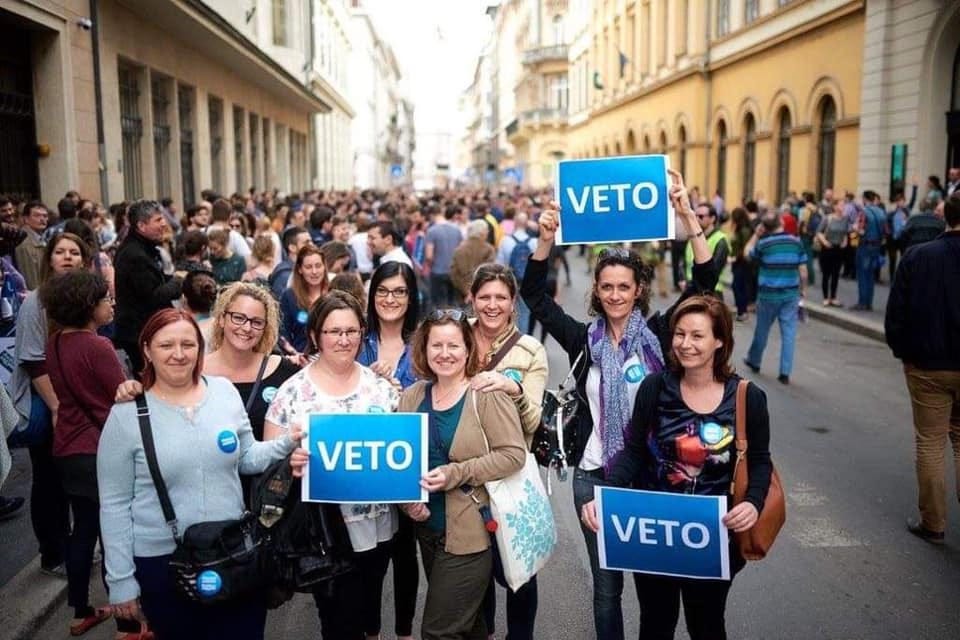
Photo: CEU
Ten years ago, the illiberal Hungarian government began its campaign against the Central European University (CEU). Back then, I was asked at a conference in Budapest: “Andrea, what will happen to you now?” The colleague who asked the question did not have me in mind, but CEU. He was a well-paid, enthusiastically loyal Fidesz apparatchik. Later, as FIDESZ moved further to the far right, he became a so-called “Fidesz orphan”, and now, in 2026, he is an advisor to the Respect and Freedom Party (TISZA), a typical example of pragmatic careerism. I replied at the time: “We’ll leave Budapest, we’ll live splendidly in Vienna, the world’s most livable city, and when everything here collapses, we’ll come back and rebuild what can be rebuilt.” I already knew back then that the System of National Cooperation, as the illiberal state built by FIDESZ is called, would eventually collapse, since no country can be run for long without professional expertise.
And here we are now: the Hungarian elections are only a couple of hours away. Péter Magyar, the leader of the opposition, is leading the polls with a serious advantage. My 2017 forecast is becoming a reality.
In the case of the collapse, I was right: other public institutions, including those in higher education and research, have indeed collapsed. However, doubts remain regarding another question: how this system is to be rebuilt. These doubts are well-grounded with respect to Magyar’s program. So far, his stated goal is to restore the autonomy of both the Hungarian Academy of Sciences and the universities, that is, to restore the pre-Fidesz status quo.
But is it possible—and, more importantly, is it necessary—to restore what has been destroyed in the past 16 years?
If a two-thirds constitutional majority for TISZA does indeed come about, Hungarian academia and higher education will still stand before a historic opportunity to build a new system more appropriate for the 21st century rather than restore the old one. This rethinking is important, as restoring what – and more importantly: those who ran these institutions – proved so vulnerable to illiberal attacks, makes little sense. As illiberal politicians and voters, and, more importantly, the business and geopolitical interests attached to them, will not disappear after the election, neither will the illiberal desire to control higher education, resources, knowledge production, authorization, and dissemination suddenly evaporate. Higher education and research should therefore be better prepared this time.
What has collapsed over the past 16 years?
Over the past decade and a half, Hungarian higher education has undergone a profound illiberal transformation. These changes have affected not only the operation of universities but also students’ life trajectories, the freedom of research, academic authorization, and the social prestige of knowledge. Although these changes were often bold and unprofessional solutions to real, existing structural problems and were communicated as “reforms to increase competitiveness,” on closer inspection, what emerges instead is the conscious impoverishment of public higher education and the building up of a parallel, centralized, well-funded, politically controlled system.
The most visible institutional change has been the transfer of universities into foundation‑based management. A significant share of state‑funded, public universities was placed under the control of asset‑management foundations. These foundations are formally “private” actors, and their boards of trustees are often populated by active or former political figures with long‑term, entrenched mandates. In theory, this model promised greater flexibility; in practice, however, it blurred the boundary between the public and private character of universities, while control over public funds did not diminish but was instead shifted to a less transparent level.
Consequently, Hungary was excluded from the Horizon programs, and the illiberal government launched its own so-called HU-rizont program, which failed miserably in terms of professional autonomy, as the ministry overruled the jury’s decisions.
Illiberal Hungary became a key factor in building up an alternative model for internationalization. The founding of the Mathias Corvinus Collegium opened a new era. The institution gained access to an extraordinary volume of state and private foundation resources, together with “dark money”, both domestically and internationally. Its educational and research activities have created a parallel system that does not fit within traditional higher education structures yet has a significant impact on them.
Trust in higher education has eroded as, over the past 16 years, key decisions on leadership, strategy, and budgets have increasingly required external political or trustee approval. As a result, self-censorship has become a dominant survival strategy within institutions.
Autonomy has not vanished entirely, but it has become conditional: it is tolerated only when it does not conflict with political or ideological priorities. Competitive, professionally reviewed grant funding has largely been replaced by centralized decisions, targeted subsidies, and designated “national priority institutions,” weakening both academic competition, trust, and, more importantly, excellence. Funding decisions are now often driven more by connections than by scholarly merit, contributing to the declining competitiveness of Hungarian science.
At the same time, Hungarian higher education faces a self-reinforcing spiral of emigration: talented students leave early to study abroad, while young researchers see no predictable academic future at home. These dynamics are compounded by demographic decline. Fewer university-age students, combined with an oversized institutional network, have pushed universities to lower admission standards to maintain enrollment. The social value of a university degree for social mobility has declined, both because it no longer reliably leads to secure careers and because intellectual work itself has lost public value due to the conscious anti-intellectualism of illiberal politics.
System change instead of rebuilding
The moment calls not for the recycling of the same actors and ideas within a rebranded system, but for new people bringing genuinely new ways of thinking and acting. The goal is not a mechanical restoration of the past, but the creation of an open, pluralistic, and competition-based academic system in which professional courage once again replaces self‑censorship.
This is a bold claim, given that the possible development has never started from so low a point, even compared with neighboring countries. But the situation is not that gloomy. There are several historical precedents that can help with rebuilding, and by now, there is a considerable, well-trained pool of scholars with international experience living in exile.
If a truly historic opportunity were to open for Hungarian higher education – and indeed, never has so much funding flowed into the system as in the past sixteen years, during which, for example, at least six twentieth-century historical research institutes with the same profile were established – these resources could be mobilized to serve new goals aligned with the challenges of the twenty-first century.
Whether CEU, together with the Hungarian higher education system, is prepared to meet these challenges, should this historical opportunity open after 12 April 2026, remains an open question, one that will ultimately test the accuracy of the second part of my forecast.