
Odysseus, the Wagnerian Hero
About the new film by Christopher Nolan

The director, Christopher Nolan, was not only envious of Coppola’s achievements but also of Wagner’s talking about war, so he transforms Odysseus into a Wagnerian hero—one who violates the divine order and is punished for it. I will tell you how.
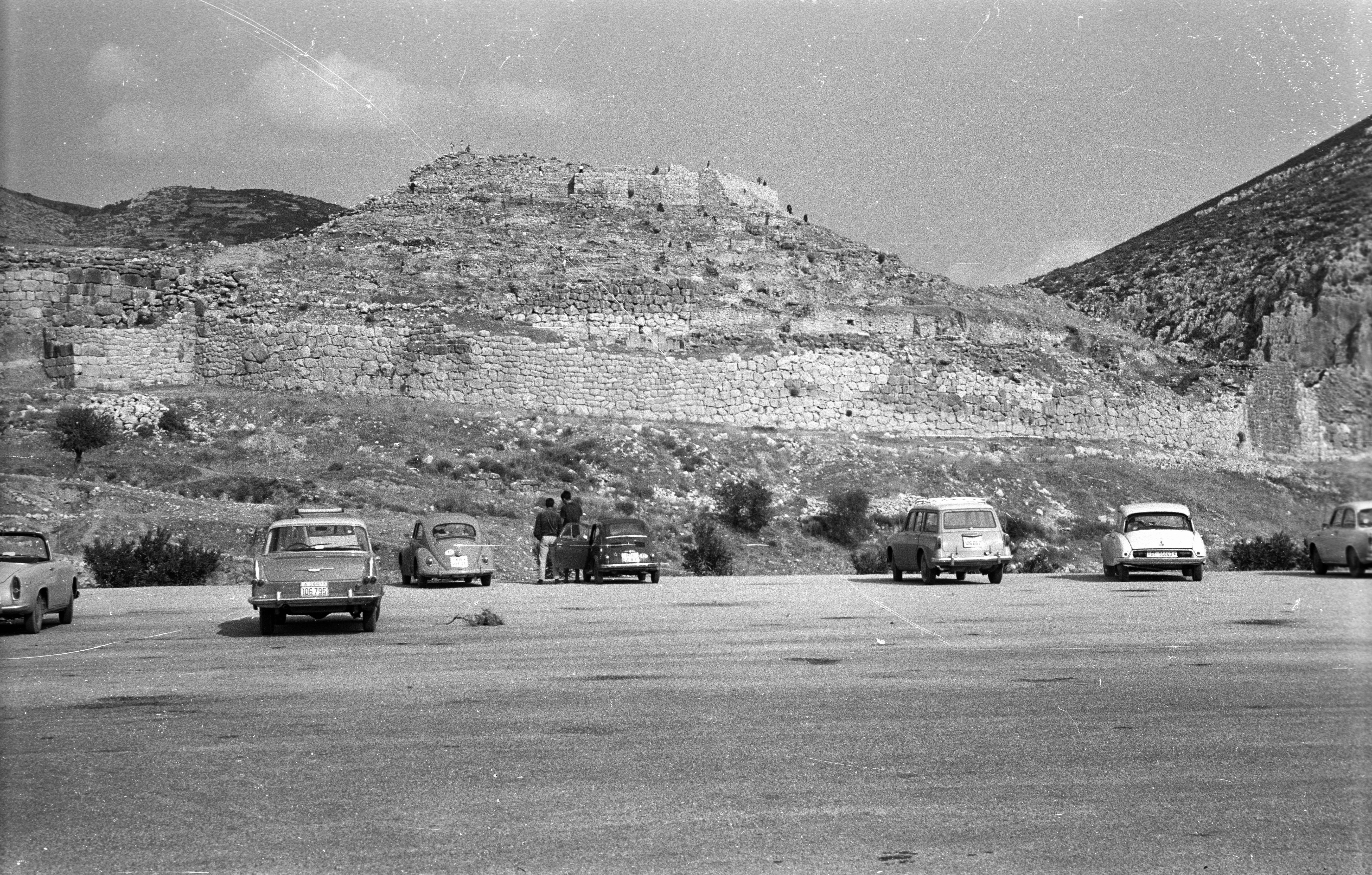
Fortepan, Greece, Mykene, 1964 , 93065, Holenár Csaba és Edina
Just as Coppola found in Heart of Darkness by Joseph Conrad, the literary material through which he could express his views on the Vietnam War in Apocalypse Now, Nolan likewise discovered a source that would allow him to communicate a very similar, yet strategically important, message to a broad audience. The Odyssey seemed an obvious choice because of its plot. At its center is a sympathetic yet complex male hero who wanders far and wide, encounters extraordinary beings, fights numerous battles, and ultimately reaches his goal. This fits neatly with the narrative expectations of contemporary audiences raised on the dramaturgy of Game of Thrones and The Lord of the Rings.
The challenge, however, lay in Homer’s magnificent text, which is layered, complex, and multifaceted. Nolan addressed this simply by translating the poem into straightforward dialogue that modern viewers can easily understand. There is little point in lamenting the fact that generations of readers over many centuries were perfectly capable of reading and understanding the original work. Nor is it worth mourning the omission or fusion of episodes from the epic, or even the fact that the warriors of the Odyssey do not wear historically accurate clothing. When Agamemnon first appears on screen as the leader of the Greek forces, viewers are initially struck speechless with fear. Only afterward do we reflect that we have seen this sort of “Dark Lord” portrayal many times before in fantasy films. Or rather, those who watch such films have. (I personally fear more men in expensive dark suits with ties.) Historical authenticity has, after all, been sacrificed rather heavily. This is not a documentary movie but an opera by Wagner with less obvious, still extraordinary music.
Nolan was not only envious of Coppola’s achievements but also of Wagner’s, for he transforms Odysseus into a Wagnerian hero—one who violates the divine order and is punished for it. Rather than reaching his goal directly, he relies on cunning ingenuity. The crafty Odysseus devises the plan of hiding inside an offering dedicated to the gods—the Trojan Horse—in order to open the gates of Troy to the enemy. Nor is that his only act of defiance. After the victory, on the journey home, he refuses to continue following Agamemnon, the commander whom he had obeyed for ten years during the siege, simply because he has grown tired of him. He abandons rationality, despite the fact that they are traveling in the same direction, and openly rebels against his superior. It is hardly surprising, then, that the gods become enraged, destroy his loyal companions through a succession of disasters, and delay his return home.
The lesson—much like in so many of Wagner’s works—is that when Odysseus reaches the nymph Calypso, who herself is no stranger to creative disobedience, he comes to understand that there is no such thing as absolute free will. He entrusts himself to the sea, abandoning his earlier hubris: the belief that he alone could solve all the problems the world placed before him. It can be interpreted as a symbolic and real suicide, the killing of the modern rational and willful man. And, of course, after this, the sea eventually carries him precisely to the destination he had always wanted to reach. The only difference is that he has wasted ten years along the way and was responsible for the comrades.
The film also repeats the familiar scholarly commonplace that the Trojan War was not fundamentally about male jealousy or the forbidden love of Paris and Helen. Rather, it was about the rational financial argument of controlling the trade routes that supplied the strategically vital metals of the Bronze Age.
Likewise, as in Heart of Darkness, the film suggests that violence and war ultimately destroy those who initiate them first.
The people and politicians of peaceful Ithaca fear the arrival of the so-called Sea Peoples, who are violent and ruthless, and would gladly prepare for war were they not preoccupied with the question of succession. Meanwhile, it gradually becomes clear that these frightening and cruel Sea Peoples are none other than the Achaeans themselves—the inhabitants of Ithaca and, above all, Odysseus.
Nobody wins.
Odysseus and Penelope sail to the realm of the dead, while Telemachus cannot fully enjoy his happiness or his golden crown, because the approaching disaster—which we already know is coming—brings an end to this civilization.
As war changes everything.
For scholars of war and political violence, there is little that is entirely new in this observation. War is easy to begin, but it rarely ends. The memory and routines of violence are passed down from father to son, from one generation to the next, and across entire families. The traumatized generations of Vietnam or Afghanistan—just to mention two well-known examples—could tell countless stories about this inheritance of violence, if only they were able to tell them and if someone were willing to listen.
Christopher Nolan succeeds in conveying this relatively simple but important message through a distinctly Wagnerian language, aided by the undervalued yet remarkably innovative music of Ludwig Göransson. Hundreds of thousands of people worldwide are watching the film. In the visually driven twenty-first century—where fewer and fewer people can understand the text of the Odyssey, partly because of educational systems that simultaneously simplify and diminish intellectual engagement—we have few other means of discussing such important questions before we ourselves become dangerous Sea Peoples. Let us hope that many will hear the film’s message. The surge in sales of Homer's original book worldwide is a hopeful sign for us all.